Contact centres are no longer just cost centres; they are strategic growth engines. Contact centre artificial intelligence accelerates that shift by automating routine work, empowering agents, and delivering faster, more personal experiences at scale. Leveraging these AI call center advantages means turning overwhelmed teams and long queues into a proactive, efficient, and genuinely customer-centric operation. This guide walks through what contact centre AI is, how it works, and how you can use it to transform both customer and agent outcomes.
Modern contact centres thrive when they integrate advanced tools and smart automation. Companies are increasingly looking at solutions like FlashMob computing platforms to enhance their data processing, which supports faster decision-making in real-time customer interactions. Beyond infrastructure, understanding the potential of high-performance supercomputers for analytics allows teams to handle large datasets without slowing down workflows, ensuring every customer inquiry is addressed promptly.
Marketing also plays a key role in improving customer experiences. Strategies from Marketing for Customers highlight how personalized campaigns and AI-driven insights can guide contact centre decisions and improve engagement. Similarly, Marketing Runners’ - modern customer communication demonstrates how coordinated campaigns and AI tools can reduce customer frustration and increase satisfaction, helping businesses stand out in competitive markets.
Financial planning and strategic resources are equally important for sustainable growth. By referencing Top Financial Resources for business optimization, managers can better allocate budgets for technology investments, ensuring that AI-powered contact centres are cost-effective and deliver measurable ROI. Even small improvements in workflow automation can translate to significant operational benefits and happier agents.
Integrating these insights, from computing innovations to marketing and finance, creates a contact centre that is not just reactive but anticipatory. The synergy of advanced data platforms and AI allows teams to predict customer needs, streamline operations, and provide meaningful support that strengthens brand loyalty. When contact centre artificial intelligence meets smart planning and insightful resources, businesses achieve a new level of efficiency, personalization, and long-term customer satisfaction.
Top 10 Contact Centre Artificial Intelligence Platforms
Contact centres are rapidly evolving, and the adoption of contact centre artificial intelligence is now critical for businesses aiming to deliver faster, more personalized customer experiences. From AI-driven routing to automated workflows, these platforms are transforming customer service operations worldwide. Here are the top 10 AI-powered contact centre solutions you should consider:
1. Bright Pattern
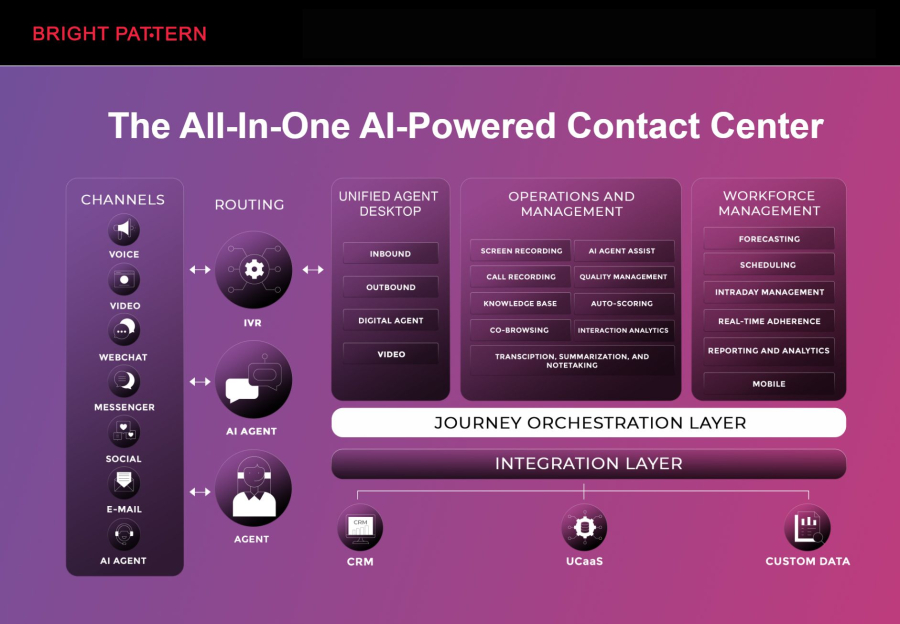
Bright Pattern is a leading contact centre artificial intelligence platform designed to make customer interactions seamless and intelligent. It provides a full suite of AI features, from omnichannel routing to automated chatbots, ensuring agents can focus on high-value interactions.
Key features of Bright Pattern include:
- Omnichannel support for voice, chat, email, SMS, and social media
- AI-powered predictive routing to connect customers to the best agent
- Advanced analytics and reporting for customer experience optimization
- Smart automation for repetitive tasks, reducing agent workload
- Seamless integration with CRM and business systems
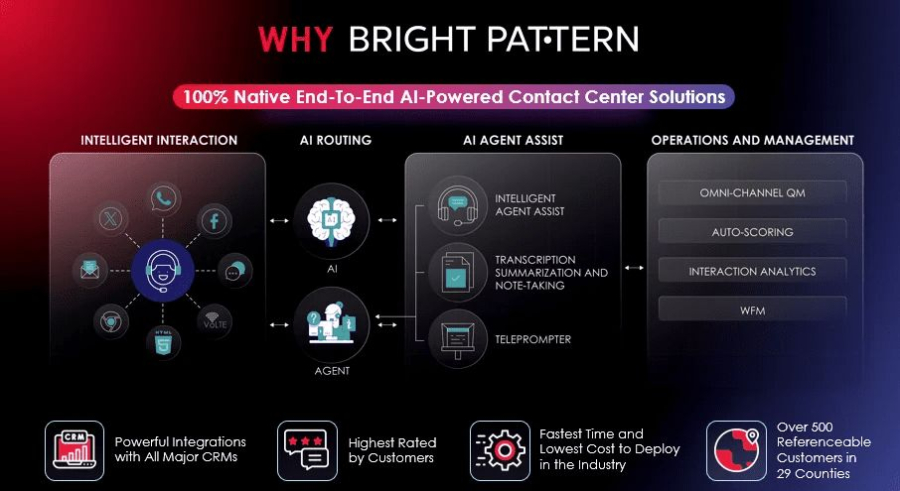
Why Bright Pattern stands out: Its AI capabilities not only streamline operations but also enable proactive customer engagement, helping businesses increase satisfaction and loyalty.
2. Genesys
Genesys offers AI-powered contact centre solutions with predictive routing, virtual assistants, and workforce optimization. Its AI helps agents anticipate customer needs and resolve issues faster.
3. Five9
Five9 provides cloud contact centre software that leverages AI for intelligent routing, automated interactions, and real-time analytics. The platform is ideal for scaling operations while maintaining personalized service.
4. NICE inContact
NICE inContact delivers AI-driven insights, chatbot automation, and omnichannel routing. Its AI helps improve agent efficiency and customer satisfaction simultaneously.
5. Talkdesk
Talkdesk integrates AI to enhance customer service with real-time guidance, sentiment analysis, and automated workflows that help reduce call times and increase resolution rates.
6. Cisco Contact Centre
Cisco’s AI-enabled contact centre solutions provide intelligent routing, analytics, and virtual assistants to optimize agent performance and customer engagement.
7. Avaya
Avaya’s AI-powered platform supports omnichannel interactions, predictive routing, and AI-driven chatbots to streamline customer communications.
8. RingCentral Contact Centre
RingCentral combines AI with cloud communication tools to deliver seamless customer experiences, including AI-assisted messaging and voice routing.
9. HubSpot Service Hub
HubSpot Service Hub uses AI to automate ticketing, provide smart responses, and analyze customer data to improve service efficiency and satisfaction.
10. 8x8 Contact Centre
8x8 offers AI-enhanced customer support with features like automated transcription, predictive analytics, and intelligent routing to create smoother customer journeys.
What Is Contact Centre Artificial Intelligence?
Contact centre artificial intelligencerefers to the use of AI technologies to enhance and automate activities across the customer service operation. It supports both customers and agents by understanding language, predicting needs, and recommending the best next action.
Key technologies that typically make up contact centre AI include:
- Natural language understandingto interpret what customers say or type in their own words.
- Machine learning modelsthat learn from historical interactions to improve decisions and predictions over time.
- Automation toolssuch as bots and workflows that can resolve tasks without human intervention when appropriate.
- Real time analyticsthat give leaders and supervisors deep visibility into performance and customer sentiment.
Importantly, contact centre AI is not about replacing humans. It is aboutaugmenting human agentsso they can focus on high value, emotionally complex, and revenue generating conversations.
Why AI in Contact Centres Is Becoming Essential
Customer expectations have never been higher. They expect fast responses, consistent answers across channels, and personalised service based on their history and preferences. At the same time, contact centres face pressure to control costs, reduce attrition, and handle growing interaction volumes.
AI offers a way to meet these competing demands by:
- Handling simple, high volume enquiries automatically.
- Helping agents work faster and with fewer errors.
- Providing leaders with real time insight to make better decisions.
The result is a more scalable operation that can support growth without linearly increasing headcount or compromising customer experience.
Core AI Capabilities Powering Modern Contact Centres
Different AI capabilities come together to form a powerful, end to end contact centre solution. Understanding these building blocks helps you decide where to focus first.
1. Conversational AI and Virtual Agents
Conversational AIpowers chatbots and voicebots that understand natural language instead of relying on rigid menus. Customers can explain their issue in their own words and receive an immediate, relevant response.
Virtual agents can:
- Answer common questions, such as billing enquiries, delivery status, or password resets.
- Guide customers through structured processes like returns, appointment bookings, or simple troubleshooting.
- Capture and validate information before handing off to a human agent, reducing average handle time.
When designed well, these AI powered assistants improve containment for basic requests while seamlessly transferring more complex issues to live agents.
2. Intelligent Routing and Triage
Traditional routing mechanisms rely heavily on simple rules such as skills based routing or language matching.AI based routingtakes this further by analysing intent, urgency, customer history, and even sentiment to decide where to send each interaction.
This enables you to:
- Prioritise urgent or high value customers automatically.
- Match customers with the best available agent based on skills, experience, and context.
- Reduce transfers, repeat contacts, and frustration.
3. Agent Assist and Real Time Guidance
Agent assisttools use AI to support agents during live interactions. They listen to or read the conversation and surface relevant information instantly.
Typical capabilities include:
- Real time suggested responses or next best actions based on what the customer just said.
- Automatic retrieval of knowledge articles, policies, or troubleshooting steps.
- Smart summarisation at the end of the interaction to reduce after call work.
By reducing the need to search across multiple systems and by removing repetitive tasks, agent assist cuts handling times and allows agents to focus on building rapport and solving problems.
4. Workforce Optimisation and Quality Management
AI dramatically enhances workforce management and quality assurance by analysing large volumes of interaction data. Instead of evaluating a small sample of calls, AI can review every conversation consistently.
Key workforce optimisation benefits include:
- Speech and text analyticsto automatically categorise interactions, detect trends, and identify coaching opportunities.
- Automated quality scoringbased on compliance markers, communication style, and resolution outcomes.
- Forecasting and scheduling supportthat uses historical patterns to predict demand more accurately.
5. Customer and Operational Analytics
AI powered analytics consolidate structured data, such as handle time and transfer rates, with unstructured data like call transcripts and chat logs. This creates a complete picture of what is happening in your contact centre and why.
With these insights, leaders can:
- Spot emerging issues before they become widespread problems.
- Identify process bottlenecks that drive repeat contacts.
- Measure the impact of changes in scripts, training, or policies.
- Feed valuable customer insights back into product, marketing, and sales teams.
Tangible Business Benefits You Can Expect
When implemented thoughtfully, contact centre artificial intelligence creates measurable improvements across service quality, operational efficiency, and employee experience.
| Area | How AI Helps | Typical Outcomes |
| Customer experience | Faster responses, personalised journeys, 24 or 7 availability. | Higher satisfaction, loyalty, and positive brand perception. |
| Operational efficiency | Automation of routine tasks and optimised routing. | Reduced handle times, fewer transfers, and lower cost per contact. |
| Agent performance | Real time guidance and reduced administrative burden. | More consistent outcomes, improved first contact resolution. |
| Leadership insight | Analytics on every interaction, not just a sample. | Better decisions on staffing, training, and process changes. |
| Compliance and quality | Automated monitoring and scoring of conversations. | Higher adherence to policies and reduced risk exposure. |
AI Use Cases Across the Customer Journey
Contact centre AI creates value at every stage of the customer journey, from initial enquiry to renewal or advocacy.
Pre Sales and Onboarding
- Lead qualification botsthat ask initial questions and route high intent prospects to the right team.
- Product information assistantsthat answer detailed questions and support comparison.
- Onboarding guidesthat help new customers get set up quickly, reducing early churn.
Post Sales Support and Service
- Self service troubleshootingthat walks customers through diagnostics and simple fixes.
- Order and account management botsfor status checks, updates, and simple changes.
- Proactive notificationsthat alert customers to issues or required actions before they need to call.
Retention and Loyalty
- Churn risk predictionthat flags at risk customers for targeted outreach.
- Sentiment analysisto understand engagement and loyalty signals over time.
- Personalised offerssuggested to agents in real time to support retention and cross sell conversations.
How AI Supports Human Agents
One of the most powerful aspects of contact centre artificial intelligence is its ability to transform the agent experience. Instead of replacing people, it removes friction from their day to day work.
Key ways AI elevates agents include:
- Less repetitive workas bots handle simple requests and post call summaries.
- Faster answersthanks to knowledge suggestions, search automation, and guided workflows.
- Reduced cognitive loadthrough clear prompts, checklists, and next step recommendations.
- More meaningful conversationsbecause agents can focus on empathy, problem solving, and relationship building.
- Better coachingpowered by insights from quality monitoring and speech or text analytics.
As a result, teams typically experience lower stress, higher confidence, and greater job satisfaction. This in turn supports better customer outcomes and reduces turnover.
Getting Started: A Practical Roadmap
Implementing contact centre AI doesn not have to be overwhelming. A phased, outcome driven approach helps you realise value quickly while building a strong foundation.
Step 1: Clarify Your Goals and Success Measures
Begin by defining what you want to achieve. Useful goals might include:
- Reducing average handle time for key enquiry types.
- Improving first contact resolution for complex scenarios.
- Increasing self service adoption without compromising satisfaction.
- Enhancing visibility into quality and compliance.
Translate these goals into specific metrics so you can track the impact of AI over time.
Step 2: Map Customer Journeys and Identify High Value Use Cases
Review your most common customer journeys and contact reasons. For each, consider where AI can have the greatest impact while still delivering a positive experience.
High value starting points often include:
- Routine enquiries with clear rules and high volume.
- Complex but structured processes where guidance can standardise outcomes.
- Areas with known pain points such as long wait times or high repeat contacts.
Step 3: Start Small, Then Expand
Launch a pilot that focuses on one or two targeted use cases. Limit the scope to a specific channel, product, or customer segment so you can iterate quickly based on real feedback.
Monitor metrics closely, gather input from agents and customers, and refine the AI intents, flows, and rules. Once the pilot is stable and delivering value, you can gradually scale to additional scenarios.
Step 4: Integrate with Existing Systems and Processes
To unlock full value, AI should connect with your core systems such as customer relationship management platforms, order management tools, and knowledge bases. Integration allows AI to access relevant data and update records automatically, avoiding duplicated work.
Equally important is aligning AI with established processes. For example, ensure escalation paths are clear when a virtual agent hands off to a human, and confirm that quality and compliance rules are embedded into AI workflows.
Step 5: Train and Support Your Teams
Agent and supervisor buy in is critical. Provide clear communication about why you are introducing AI, how it will help, and what will change in day to day operations.
Offer training on how to work effectively with AI tools, including:
- Using agent assist suggestions while still exercising judgment.
- Intervening smoothly when a virtual agent transfers a conversation.
- Leveraging analytics dashboards to drive coaching and improvements.
Best Practices for Successful AI Adoption in the Contact Centre
To maximise the benefits of contact centre artificial intelligence, keep these best practices in mind.
Design with the Customer in Mind
Always start from the customer perspective. Design AI interactions to be natural, helpful, and transparent. Make it easy to reach a human when needed, and avoid forcing customers through long automated flows that do not add value.
Combine Automation with Human Empathy
Use AI to handle tasks, not relationships. For emotionally charged or complex issues, human empathy remains essential. Ensure your routing strategy quickly connects these contacts to skilled agents who have the right context on screen.
Treat AI as a Living System, Not a One Time Project
AI models and conversation flows improve over time. Regularly review transcripts, feedback, and performance data to refine intents, update knowledge, and adjust rules. A continuous improvement mindset keeps your AI aligned with changing products and customer expectations.
Prioritise Data Quality and Governance
AI is only as good as the data it learns from. Invest in data cleanliness, consistent tagging, and clear governance around how customer information is used. Strong data practices support more accurate models and builds trust with customers and regulators.
Measure What Matters
Track both operational and experience oriented metrics. For example:
- Automation rates and task completion for virtual agents.
- Handle time, first contact resolution, and transfer rates for human assisted contacts.
- Customer satisfaction and effort scores across channels.
- Agent engagement, adoption of AI tools, and feedback trends.
Balanced measurement ensures you are not improving one metric at the expense of another.
Common Myths About Contact Centre AI
Despite its growing adoption, several misconceptions still surround contact centre artificial intelligence. Addressing these early helps build confidence among stakeholders.
Myth 1: AI Will Replace All Contact Centre Agents
In practice, AI is most effective when working alongside humans. It takes care of repetitive work and information retrieval so agents can focus on high value interactions. Organisations that adopt AI typically redesign roles rather than eliminate the human element.
Myth 2: AI Only Works for Simple Enquiries
While AI is well suited to straightforward tasks, modern systems can also support more complex scenarios. They do this by gathering context, guiding both customers and agents through structured steps, and recommending personalised actions based on data.
Myth 3: Implementing AI Is Too Complex and Expensive
Advances in cloud platforms and pre built models have significantly lowered the barrier to entry. You can now start with focused use cases, prove value quickly, and expand over time rather than committing to an all or nothing transformation.
Myth 4: Customers Dislike Interacting with AI
What customers generally dislike ispoorly designedautomation. When AI is fast, accurate, and easy to escape from when needed, many customers prefer it for simple tasks because it saves them time. The key is to design experiences that are genuinely helpful.
Looking Ahead: The Future of AI Powered Service
Contact centre artificial intelligence is evolving rapidly. Capabilities such as generative AI, predictive engagement, and real time behavioural insight are extending what is possible. Over time, contact centres will become more proactive, anticipating needs and resolving issues before customers even have to reach out.
By starting now with clear goals, customer centric design, and a focus on augmenting your people, you can build a resilient, future ready operation. The payoff is a contact centre that consistently delivers quick, accurate, and personalised experiences while empowering agents to do their best work.
When every interaction is informed by intelligence and delivered with empathy, your contact centre becomes a powerful differentiator and a driver of long term customer loyalty
